
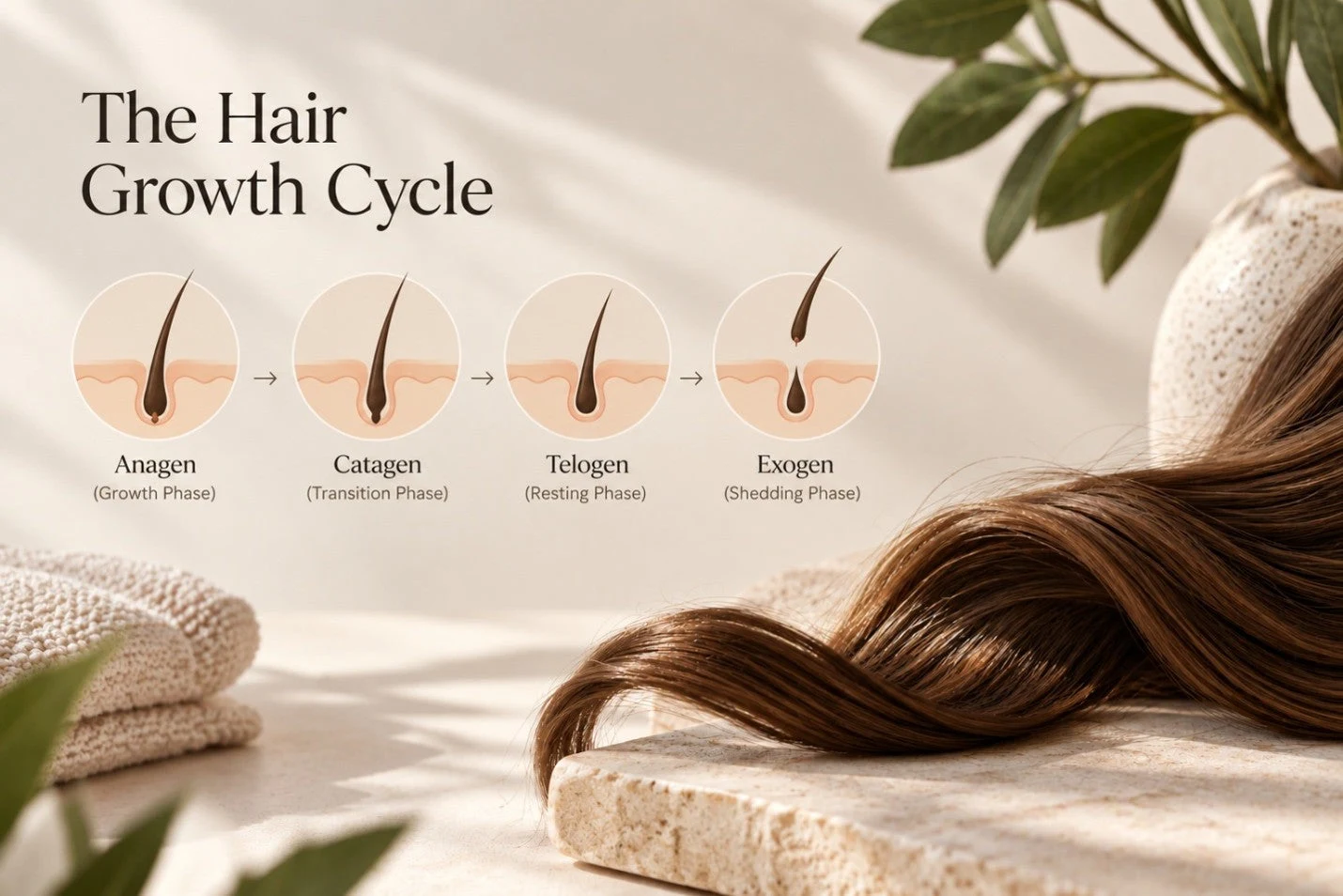
With somewhere between 80,000-120,000 hairs on our heads, it’s astonishing to think that each hair is in its own growth cycle. Some hairs are growing while others are getting ready to leave your head, each hair has its own journey.
What is the hair growth cycle?
The hair growth cycle is an ongoing cycle that every hair follicle goes through repeatedly through your lifetime. There are four phases of the cycle, each with its own job responsibilities. Every hair grows from a hair follicle in your scalp. These follicles are fed by blood vessels that bring needed nutrients that support growth.
What are the 4 phases of hair growth?
The four phases of hair growth include anagen, catagen, telogen and exogen. Every hair goes through all four phases.
· Anagen: The Growth Phase. Anagen is when your hair is actively growing. It’s also the longest phase of the hair growth cycle. At any given point, the majority of your hairs are in the anagen phase.
· Catagen: The Regression/Transition Phase. The hair follicle is no longer nourished by the bloodstream, so the follicle transitions out of the growth phase. Growth slows down. This is a short phase, so only a few hairs are in this phase at any point.
· Telogen: The Resting Phase. The hair prepares to separate from the hair follicle. A small percentage of hairs are in the telogen phase.
· Exogen: The Shedding Phase. During this phase, the hair is naturally released from your head and the cycle is completed. Meanwhile, the next growth cycle has already begun.
How many days is a hair growth phase?
Each phase of the hair growth has a different length, none of which are typically measured in days. Some phases last for weeks or months, others for years.
· Anagen: This growing phase lasts for at least 2-8 years. As you age, the length of the anagen phase may decrease.
· Catagen: This transition phase is just a few weeks long.
· Telogen: This resting phase typically lasts a few months.
· Exogen: This is a short period where the hair is shed, and the hair follicle is ready for a new anagen phase.
Should hair come out when running fingers through it?
There can be a few hairs that come out while running your fingers through your hair. Shedding 50-100 hairs per day is normal, and these are the hairs that are in the exogen (shedding) phase. If you feel like you have significant amount of hairs shedding regularly, reach out to your healthcare professional to discuss.
How can you tell when your hair is in anagen phase?
You can tell your hair is in the anagen phase if it is growing. Most of your hair is in the anagen phase, as the anagen (growth) phase is several years long.
How do you know when your hair growth phase is done?
Unfortunately, you can’t exactly tell when a hair’s growth phase is done. When the hair growth cycle is complete, then the hair will fall out and is shed. That lets you know that a complete cycle has finished. What’s exciting is that before one hair is shed, the hair follicle is already working on the next cycle.
What stops hair growth?
There are several things that can disrupt the hair growth cycle and stop hair growth. Factors like stress, illness, aging, genetics, and your hormones can all impact your hair growth. For example, stress can have major impacts on the hair growth cycle, causing your hair to jump more quickly into the telogen (resting) phase than usual. This stress-induced disruption is called telogen effluvium and will usually resolve when the stress is removed.
Aging has many impacts on the body, including changes to how our hair grows. One change is that your hair follicles may begin shrinking as you get older, resulting in slower growing and finer hair. For some people as they age, their hair growth cycle shortens over time until the follicles no longer continue growing hair. Some hormones are also shown to impact the hair growth cycle.
If you have questions about your hair growth, speak with your health care professional who can discuss your unique hair situation with you.
Is there a supplement to help support my hair growth cycle?
Viviscal 4D Hair Growth Cycle Supplement helps to support your hair growth cycle and enhances your hair’s fullness±, strength, shed control, hair & scalp health.* Viviscal 4D hair is formulated with a keratin nutrient complex and other key vitamins and minerals to support healthy hair.* You could start to see improvements in your hair’s appearance after 1 month of daily use, and stronger hair after 3 months.*^
Good Hair Days: The hair growth cycle is designed to keep the majority of your head covered in hair, making sure there’s an ongoing supply of hair. As a hair finishes the hair growth cycle, the hair follicle begins the process again. While stress, illness and aging can impact your hair growth cycle, it’s important to understand how the hair growth cycle should work so that you can identify when you might be having issues and speaking to your healthcare provider.
Brought to you by the Viviscal™ nutrition experts.
±Due to less shedding
^Based on a 90-day randomized, double-blind, placebo-controlled study involving 50 women with signs of damaged hair.