
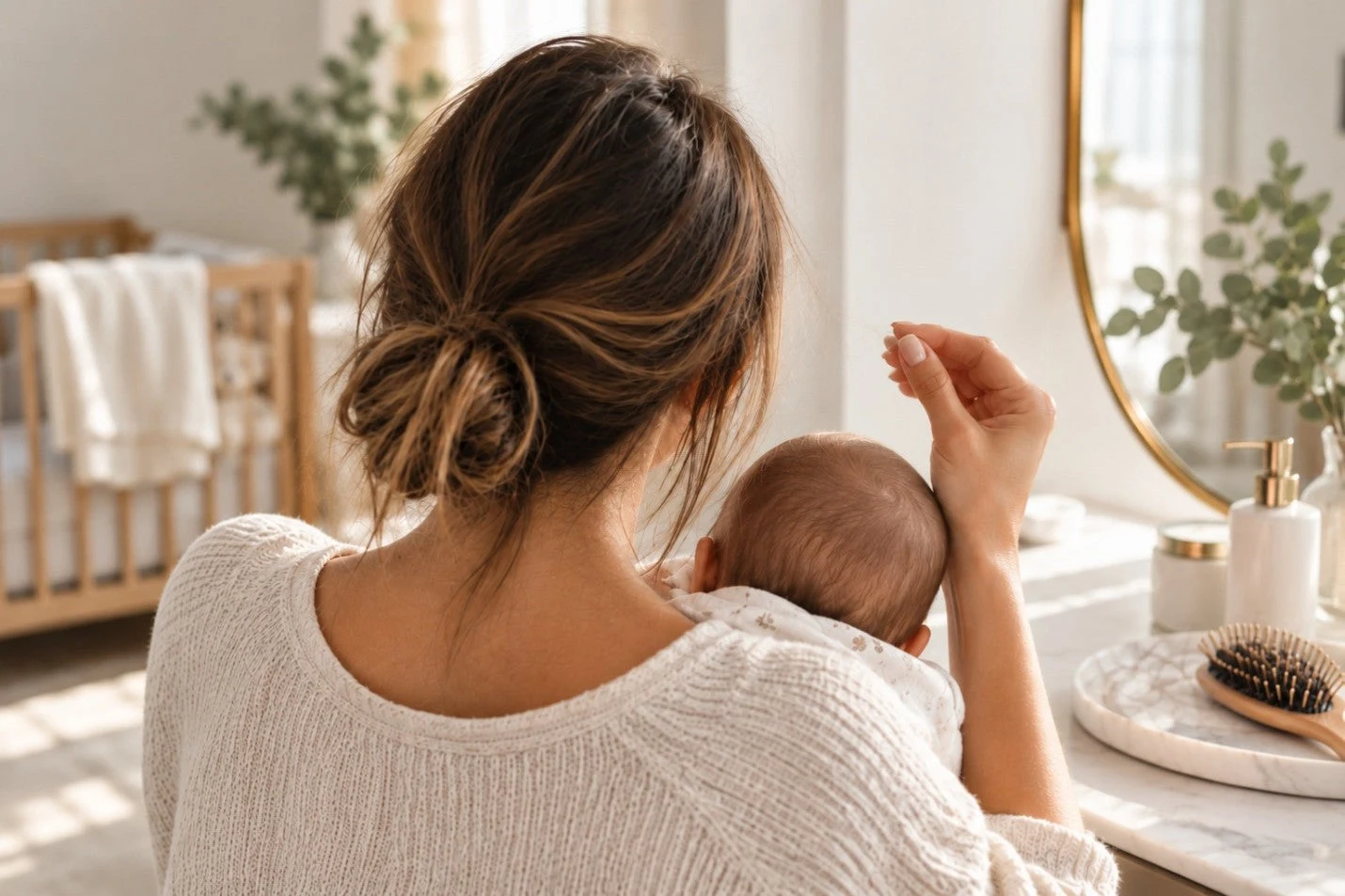
Got the postpartum hair blues?
Bringing a baby into the world changes your whole life and brings many changes to your body. One of these changes you may see has to do with your hair. A few months after the big excitement of having a baby, you may be surprised to find your hair sheds more than you’ve seen before. What’s happening? Why are you losing hair after your baby’s birth? This hair loss can feel very upsetting, but in fact it’s normal.
What is postpartum hair shedding?
Postpartum hair shedding, as known as postpartum hair loss, is a form of telogen effluvium. This stress-based hair shedding happens due to changes in your hair growth cycle after the baby comes. While pregnant, your body may hold onto more hairs than normal, while after delivery, your body moves those hairs to the shedding phase moving more hairs to be shed at a time. To better explain, let’s start with an overview of the hair growth cycle. The hair growth cycle has four stages – the growth phase (anagen), regression phase (catagen), resting phase (telogen) and the shedding phase (exogen). When you are pregnant, your hair stays in the growth (anagen) phase for longer. This explains why there’s often very little hair shedding during pregnancy. There’s even an increase in hair diameter, which means that your hair gets a bit thicker. This is why many people feel like their hair is fuller when they are pregnant.
Once you’ve had the baby, your body starts the process of adjusting to its pre-pregnancy state, including hormone shifts. Some of the hair that had been in an extended anagen phase is quickly pushed into the resting phase (telogen). That’s why postpartum hair shedding is considered a form of telogen effluvium. The telogen phase typically lasts a few months. Postpartum hair shedding begins as this phase ends. So, this shedding would be a few months after the birth of the baby.
How long does postpartum hair loss last?
Postpartum hair usually peaks about 4 months after the baby is born. Your hair shedding should improve over the next few months and is usually resolved by about 12 months. If you are concerned about how long your postpartum hair loss is continuing, speak with your healthcare provider to determine if there is something else going on.
When does postpartum hair loss end?
Postpartum hair loss usually ends on its own naturally a few months after it began. It can feel upsetting when it’s happening, but it’s a natural part of the process of recovering from pregnancy.
How can I avoid postpartum hair loss?
Postpartum hair loss is not necessarily something you can avoid. While it can feel scary to see so much hair shed, it’s really a result of changes to your hair growth cycle when you were pregnant. Keep in mind, not everyone experiences noticeable postpartum hair loss.
What are steps you can take to help postpartum hair loss? While you are waiting for the shedding to resolve, follow these tips to help your hair:
· Adjust your hair care routine:
o Choose volumizing shampoo and conditioners, which are designed to help make hair look fuller. These are often formulated for fine hair, which means that they are created to not weigh down your hair.
o Avoid conditioners that are labelled “deep conditioning” or “intensive conditioning.” These types may be heavy conditioners that can weigh down your hair and make it look less full.
· Support hair growth by continuing to eat well. Eating nutritious foods helps to ensure that the nutrients you need for recovering from pregnancy as well as hair growth are available for your body.
· Even though you are taking care of a baby, it’s also important to take care of yourself. Going for walks when you can, talking to friends, and finding other stress-relieving activities can also help.
Slow but Steady: Your hair will come back. While postpartum hair loss can feel concerning, it can be a normal part of the postpartum period for many women. As your body recovers from the birth, and the hair growth cycle returns to normal, your hair will recover as well. As with many parts of the postpartum recovery experience, if you have any concerns, speak with your healthcare professional for guidance.
Brought to you by the Viviscal™ nutrition experts.